Cold Start Guide: 2022 Harley-Davidson Forty-Eight (XL1200X)
Cold Start Guide: 2022 Harley-Davidson Forty-Eight (XL1200X)
Quick Reference Table
| Spec | Value | Source |
|---|---|---|
| Engine | Evolution 1200 (1,202cc) air-cooled V-twin, OHV 2-valve | Harley-Davidson |
| Fuel System | Electronic Sequential Port Fuel Injection (ESPFI) | H-D Service Manual |
| Battery Type | AGM (Absorbed Glass Mat), 12V | H-D Owner Manual |
| Recommended CCA | Minimum 260 CCA at 0° F | H-D Parts Catalog |
| Idle RPM (Cold) | 1,150-1,250 RPM | H-D Service Manual |
| Idle RPM (Warm) | 1,000-1,050 RPM | H-D Service Manual |
| Choke/Enrichment | None — Auto-enrichment via ECM | H-D Service Manual |
| Fuel Octane | 91 RON (87 AKI) minimum | H-D Owner Manual |
| Cold Start Temp Range | 0° F to 100° F (-18° C to 38° C) | H-D Engineering Specs |
| Peak Power Output | ~67hp / 72 lb-ft torque | H-D Dyno Specs |
| Transmission | 5-speed with wet clutch | H-D Specifications |
| Final Drive | 1-1/8" (29mm) width belt, 66-tooth rear pulley | H-D Service Manual |
| Fuel Tank Capacity | 2.1 gallons (peanut tank) | H-D Specifications |
| Wet Weight | ~564 lbs (wet, standard setup) | H-D Specifications |
| Front Tire | 130/80B-19 (fat tire, unique handling characteristic) | H-D Specifications |
Difficulty & Time Estimate
- Difficulty Level: Beginner (1 out of 5) — fully automatic cold-start procedure, no manual choke
- Estimated Time: 4-6 minutes from key-on to rolling idle (cold engine)
- Seasonal Note: Below 40° F, allow additional 3-5 minutes of warm-up before riding
- The Evolution 1200 shares its architecture with the 883 but with larger displacement — more torque and slightly different cold-start characteristics
- The 2.1-gallon peanut tank is the smallest in the Harley lineup — fuel level monitoring is critical, especially in cold weather when mileage drops
- The 130mm fat front tire is a unique Forty-Eight feature — it affects steering geometry and warm-up handling on cold, slick surfaces
- The Forty-Eight was discontinued after the 2022 model year — this article covers the final-production specifications
- Mini-ape handlebars bring the controls closer to the rider but require specific hand positioning in cold weather gloves
Pre-Start Checklist
| Checkpoint | Status | Notes |
|---|---|---|
| Battery Voltage | ≥ 12.6V | Use multimeter on battery terminals; below 12.4V may struggle in cold |
| Fuel Level | Adequate | 2.1-gal peanut tank = limited range; ESPFI needs minimum fuel pressure; do not start below 1/4 tank in cold |
| Oil Level | Between marks | Check dipstick on level ground; engine OFF; Evolution uses 20W-50 |
| Tire Pressure | 36 PSI front / 39 PSI rear (cold) | 130mm fat front tire needs correct pressure for proper handling |
| Kill Switch | RUN position | Right handlebar controls — mini-ape position makes reach easier with gloves |
| Transmission | Neutral | Green neutral light must be illuminated on instrument cluster |
| Kickstand | Up | Safety interlock prevents start in gear with stand down |
| Key/Fob | Present | H-D Smart Security system requires fob proximity within ~3-6 ft |
| Drive Belt | Inspect visually | Check belt for cold-stiffness cracks before riding |
| Front Fork Condition | Check for leaks | Fat tire loads front suspension differently; verify fork seals are sound |
Step-by-Step Cold Start Instructions
Step 1: Pre-Ride Visual Walkaround
Before approaching the controls, walk around the Forty-Eight. Check for fluid leaks, loose items, or obstructions. The Evolution 1200 engine sits low and exposed in the Sportster frame — look for ice buildup around the head fins, pushrod covers, and oil lines. Inspect the mini-ape handlebars for ice on the grip surfaces; the shorter bar height compared to taller ape hangers means less exposed surface area but the grips sit nearly level with the tank. Check the 2.1-gallon peanut tank for frost on the cap and filler area. In freezing conditions, inspect the drive belt for surface cracking.
Step 2: Verify Kill Switch Position
Locate the kill switch on the right handlebar switch housing. Slide it to the RUN position (green arrow icon). The Forty-Eight's mini-ape bars place the controls closer to your natural hand position than standard bars, but the upward angle of mini-apes means you reach slightly upward. With cold-weather gloves, this is actually more comfortable than reaching forward. Confirm the switch is in RUN.
Step 3: Ensure Fob Proximity or Insert Key
Turn the ignition key to ON — or if equipped with proximity keyless ignition, ensure the fob is within range. The analog speedometer with integrated LED indicator lights (a classic Forty-Eight styling cue) will illuminate. You will hear the fuel pump prime for approximately 2-3 seconds, a brief whirring sound from beneath the peanut tank. The compact tank design places the fuel pump in a tight space that may cold-soak more quickly than larger tanks.
Step 4: Wait for Fuel Pump Priming
Do not press the starter button immediately. Wait 3-5 seconds for the ESPFI system to build fuel pressure. In cold weather below 32° F, the pump may cycle slightly longer — this is normal. With only 2.1 gallons of fuel capacity, the peanut tank has less thermal mass than larger tanks, meaning the fuel inside reaches ambient temperature faster — this can affect vaporization in extreme cold. Rushing this step causes hard starts on fuel-injected Evolution engines.
Step 5: Confirm Neutral and Pull In the Clutch
Ensure the transmission is in neutral (green neutral light illuminated). Pull in the clutch lever fully. This disengages the wet clutch pack and removes the drag of thick cold transmission oil from the crankshaft — especially important on the Evolution 1200, whose larger displacement makes it slightly harder to crank when the oil is cold. The Forty-Eight's mid-mount controls and low solo seat position place your body weight directly over the frame backbone — a stable position for clutching in cold weather.
Step 6: Press the Starter Button
Press the starter button on the right handlebar. Hold for 2-4 seconds. The Evolution 1200 should fire within this window. The larger 1,202cc displacement draws 70-100 amps during cranking — slightly more than the 883. Do not hold the starter for more than 5 seconds at a time. If the engine does not start, release the button and wait 10 seconds before retrying.
Note: No throttle input is needed. The ECM controls the air-fuel ratio for cold enrichment automatically through the ESPFI system. The Evolution 1200 has used electronic fuel injection since 2007 on all Sportster models.
Step 7: Observe Initial Idle
Once started, the engine will idle at an elevated RPM (approximately 1,150-1,250 RPM). This is the ECM cold idle strategy. The Evolution 1200 produces a deeper, richer exhaust note than the 883 due to larger displacement and the distinctive dual exhaust with staggered outlets. The rubber-mounted engine absorbs most frame vibration, but the low solo seat allows you to feel direct engine harmonics through the seat pan during cold idle.
Step 8: Allow Initial Warm-Up (30-60 Seconds)
Let the engine settle for 30-60 seconds. You will hear the RPM gradually decrease as the oil warms and the ECM reduces enrichment. During this time, verify all instrument cluster warning lights have extinguished. The Forty-Eight's classic analog speedometer with LED warning indicators is simple and reliable — no complex digital display that slows down in cold weather. Check that the neutral light, oil pressure, and security indicators have all cleared.
Step 9: Check for Warning Indicators
Confirm that the oil pressure light (if equipped), ABS light (if optional ABS is installed), and security light have all turned off. If any warning light remains illuminated after 10 seconds of running, shut off the engine and diagnose before riding. The 2022 Forty-Eight was in its final production year with mature, well-sorted electronics — warning light issues are uncommon unless the fob battery is low or the battery voltage is marginal.
Step 10: Listen for Proper Exhaust Firing
The Evolution 1200 fires on both cylinders once warming begins. Listen for smooth, rhythmic exhaust pulses — the 45-degree V-twin with rubber mounting produces a characteristic deep thump at idle that is more pronounced and satisfying on the 1200 than the 883. If you hear irregular firing, misfiring, or a single-cylinder sound, do not ride. The 1,202cc engine has larger combustion chambers and may show single-cylinder misfire more readily if a spark plug wire has degraded.
Step 11: Begin Gentle Warm-Up Riding
After the RPM stabilizes near warm idle (1,000-1,050 RPM), you may begin riding. Keep RPM below 3,000 for the first 1-2 miles, avoid hard acceleration, and use engine braking gently. The Forty-Eight's 67hp and 72 lb-ft of torque give it noticeably more pulling power than the Iron 883 — this extra torque is tempting but resist the urge during warm-up. The 130mm fat front tire requires the first few miles to warm up for full grip; cold front rubber on the wide 19-inch profile is especially slick on cold surfaces. The mini-ape handlebars bring your hands closer to your body — an ergonomic advantage in cold weather, reducing wind exposure to your arms.
Step 12: Monitor the 2.1-Gallon Peanut Tank
This is unique to the Forty-Eight: the 2.1-gallon peanut tank offers approximately 100-140 miles of range depending on riding conditions. In cold weather, fuel efficiency drops 10-15%, further reducing range. Always check fuel level on the analog gauge before riding in cold weather — running out of fuel on a cold day while managing the fat front tire on unfamiliar roads is a scenario you want to avoid. With only 2.1 gallons, the fuel system has no reserve — the low-fuel light is your only warning, and in cold weather it can come on with less than 30 miles remaining.
Step 13: Cold Weather Extended Warm-Up (Below 40° F)
If ambient temperature is below 40° F, extend the stationary warm-up to 3-5 minutes before riding. The Evolution 1200 is air-cooled only — no supplemental oil cooling — and relies entirely on airflow for temperature regulation. In extreme cold (below 20° F), allow 5-8 minutes of warm-up total. The smaller peanut tank cools fuel faster than larger tanks; in very cold conditions, fuel at the bottom of the tank may be noticeably colder. Verify the fob battery is fresh.
Seasonal & Temperature Guide
| Temperature Range | Procedure | Notes |
|---|---|---|
| Below 20° F (-7° C) | 5-8 min warm-up; verify fob battery; battery tender overnight | Air-cooled Ev takes longest to warm; fat front tire needs extra warm-up miles; small tank = check fuel before every ride |
| 20-40° F (-7 to 4° C) | 3-5 min warm-up; pull clutch for start | AGM battery output reduced by ~30% at 32° F; extra torque demands gentle throttle until warm; peanut tank cools fuel faster than larger tanks |
| 40-60° F (4 to 16° C) | 1-2 min warm-up; normal start procedure | Ideal cold-start conditions for Evolution 1200; fat front tire handles well once up to minimal temp |
| Above 60° F (16° C) | 30-60 sec warm-up; normal start | Minimal enrichment needed; the 1200 is ready to ride quickly in warm weather |
Tips, Warnings & Common Mistakes
Helpful Tips
- The Evolution 1200 has used ESPFI since 2007 — no choke, no manual enrichment, fully automatic cold start
- The peanut tank (2.1 gal) is the smallest in the Harley lineup — always fill before a cold ride; low-fuel light with cold weather = very limited range
- The 130mm fat front tire is iconic but requires extra attention in cold weather — wider contact area can actually be advantageous on cold surfaces once warm
- Battery condition is the #1 factor in reliable cold starts — test annually before winter
- Mini-ape handlebars reduce wind exposure to your hands in cold weather — consider bar-end weights for vibration damping
- The Forty-Eight's solo seat provides minimal insulation from the cold frame — consider a heated seat pad for cold rides
- Use a battery tender (CTEK or BatteryMINDer) during winter months for reliable daily starts
- The 1,202cc Evolution has more torque reserve than the 883 — this means easier warm-up riding at lower RPM
Warnings
- NEVER hold the starter button for more than 5 seconds continuously — overheats starter motor and drains battery
- NEVER use starting fluid or ether on a fuel-injected Harley — this can cause engine damage or fire
- Do not rev the engine aggressively during warm-up — cold oil has not yet reached the cam bearings and lifters
- Never ride with the peanut tank below 1/4 in cold weather — fuel delivery issues compound with cold temperatures
- The 130mm fat front tire requires extra warm-up distance on cold surfaces — it is wider and takes longer to heat than standard tires
- The low solo seat height means cold air flows under your body more directly — use windproof leg layers
Common Mistakes to Avoid
| Mistake | Consequence | How to Avoid |
|---|---|---|
| Not waiting for fuel pump prime | Hard start or flooding | Always listen for the 2-3 second pump whir before pressing starter |
| Blipping throttle during cold start | Disrupts ECM enrichment map | Hands off the throttle entirely during cranking |
| Starting with kill switch in OFF | Nothing happens — confused diagnosis | Always verify RUN position first |
| Riding hard before warm-up | Increased cam and lifter wear | Gentle riding for first 2 miles minimum; RPM below 3,000 |
| Ignoring low battery voltage | Slow crank, no-start in cold | Test voltage monthly during winter; keep above 12.4V |
| Riding with low fuel in cold | Stranded with no range margin | Never leave the driveway below 1/2 tank in cold weather on the Forty-Eight |
| Not warming up fat front tire | Reduced front-end grip in early miles | Gentle straight-line acceleration for first 0.5 mile to warm the 130mm tire |
| Overlooking peanut tank cap seal | Cold air entering tank affects fuel pressure | Inspect cap gasket annually; replace if brittle |
| Ignoring belt condition in cold | Belt slippage or snap | Inspect belt every cold season; replace if cracked |
Battery Maintenance for Cold Starts
| Item | Recommendation |
|---|---|
| Battery Type | AGM 12V, 260+ CCA |
| Cold Weather Impact | AGM retains ~70% capacity at 32° F vs. ~100% at 72° F |
| Battery Tender | CTEK MXS 5.0 or BatteryMINDer 2012 — connect during storage |
| Replacement Interval | Every 3-5 years, or when CCA drops below 80% of rated |
| Winter Storage | Connect to smart charger; check voltage every 2-3 weeks |
| Terminal Torque | 20-30 in-lbs for battery terminal bolts — check annually |
The Evolution 1200 draws 70-100 amps during cranking — more than the 883 due to larger displacement. The Forty-Eight's compact peanut tank design means the battery sits in a relatively exposed position beneath the solo rider seat, with less thermal insulation than larger models. Any battery degradation has outsized impact in cold weather. The Forty-Eight's minimal electronics (no Boom! Box, no large TFT — clean analog gauge with LED indicators) help reduce parasitic drain, but the battery must still meet CCA requirements. Replace batteries proactively before winter. In climates below 20° F, a battery thermal wrap is recommended.
Troubleshooting
| Symptom | Likely Cause | Fix |
|---|---|---|
| Engine cranks but will not start | Fuel pump not priming, flooded, or security fault | Listen for pump prime; wait 10 seconds and retry; verify fob within range |
| Slow cranking sound | Weak battery, corroded terminals, or cold-thick oil | Clean terminals, charge/test battery, connect to tender |
| Clicking but no crank | Dead battery or faulty starter solenoid | Charge battery to 12.6V+, check solenoid connections and ground strap |
| Engine starts then dies immediately | Idle air control valve sticky, security fault, fuel delivery | Check security light; clean IAC; verify fuel pump operation |
| Single-cylinder fire on cold start | Weak ignition coil, bad spark plug wire — common on Ev engines | Check coil resistance; replace plug wires if over 5 years old |
| Rough idle during warm-up | Normal cold enrichment — ECM adjusting mixture | Allow 2-3 minutes; if persistent, check TPS and IACV operation |
| Fuel gauge reads empty in cold | Sending unit affected by cold fuel density | Verify actual fuel level physically; fuel gauge can read low in cold conditions |
| Belt squeal on cold start | Belt stiffened and glazed from cold | Normal for first moment; if persistent, inspect belt and pulley alignment |
Verification Notes for 2022 Model Year
| Item | Known Value | Notes |
|---|---|---|
| Cold idle RPM | 1,150-1,250 RPM | Verify on warm-up; should settle to 1,000-1,050 RPM when warm |
| Battery CCA | 260+ CCA recommended | Check actual battery spec tag on installed unit |
| Engine oil grade | SAE 20W-50 per H-D specification | Evolution 1200 uses standard H-D Formula+ 20W-50 |
| Fuel system | ESPFI (auto-enrichment since 2007) | No choke cable or manual enrichment — fully automatic |
| Starter current draw | 70-100 amps during crank | Higher than 883 due to larger displacement; verify with amp clamp if suspect |
| Security system | H-D Smart Security with keyless | Fob must be detected; immobilizer prevents start without fob |
| Fuel tank capacity | 2.1 gallons (peanut tank) | The defining Forty-Eight feature — always check level |
| Front tire size | 130/80B-19 (fat tire) | Unique handling characteristic; pressure critical |
| Rear tire size | 150/80B-16 | Standard Sportster rear |
| Final production year | 2022 | Discontinued by H-D after 2022; collectible status |
To verify all specifications, check your 2022 Forty-Eight owner manual included with the motorcycle, or access it through the Harley-Davidson mobile app.
This guide was prepared using Evolution 1200 service manual specifications and Harley-Davidson OEM cold-start procedures. Always verify against your specific owner manual. The 2022 Forty-Eight was the final model year for this motorcycle — the last of the classic Sportster Evolution line before H-D's transition to the Revolution Max platform. Its distinctive features include the 2.1-gallon peanut tank (the smallest of any Harley), the 130mm fat front tire (unique in the lineup), mini-ape handlebars, and the fat-fender retro styling. The Evolution 1200 engine requires SAE 20W-50 oil and uses ESPFI. With its discontinued status, Forty-Eight owners should maintain their bikes carefully — replacement parts for the unique peanut tank and front-end setup may become harder to source over time.
Parts for this job
Fits XL1200X, XL1200, XL — from our catalogue of 41,000+ aftermarket parts.
 OE Factory Spark Plug$6.35
 Ignition System Cover Allen Screws$8.59
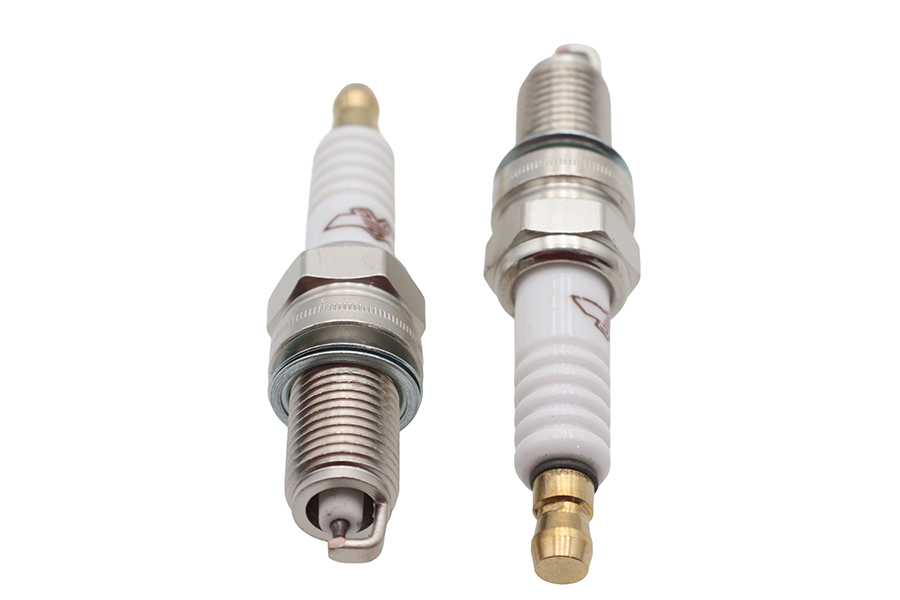 Ultima Peformance Spark Plugs$9.72Chrome Spark Plug Cover$10.64Ignition Point Cover Mount Kit Chrome$10.69
 XL Starter Gasket$11.88Ignition System Cover Allen Screw$12.00
 8mm Spark Plug Wire Set$17.12Ignition Coil Mounting Plate Kit Chrome$18.74
 Stick Starter Lever Base Zinc$21.47
 *UPDATE Autolite Platinum Spark Plug Set$23.84
 V-Twin Performance Spark Plug Set$24.34